


Creating innovations together through get started 2gether
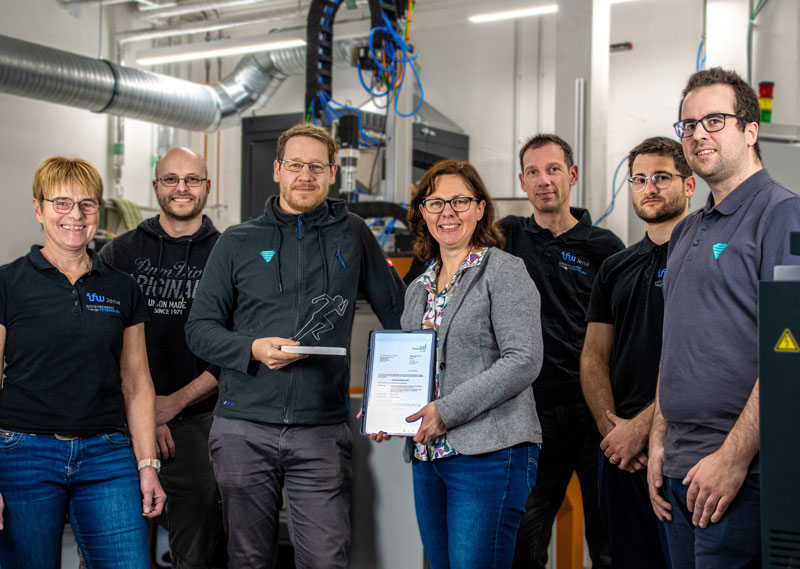
ShapeFab develops solutions for the precision machining of brittle materials such as glass and ceramics.
At get started 2gether in September, the company presented its idea of further developing CO2 laser polishing of glass components and the manufacture of ceramic components using additive manufacturing processes in order to tap into new high-end markets.
On the one hand, glass polishing with CO2 lasers is to be optimized in order to efficiently manufacture glass components for special applications. ShapeFab has already developed a CNC manufacturing technology that integrates all manufacturing steps for high-precision glass components in a single machine. This represents a major advantage over conventional multi-stage manufacturing methods using different equipment. However, mechanical polishing is too slow and therefore not economical enough for particularly large polished geometries. CO2 laser polishing offers faster processing times and lower surface roughness as an alternative.
The research funding from get started 2gether is intended to address the existing limitations of CO2 laser polishing. The focus is on the repeatability of the process, especially for complex geometries, and on improving the precision of the process for use with particularly thin substrates and for surfaces that require very low roughness. The ifw Jena is available to ShapeFab as a research partner and contributes its diverse experience in laser polishing with CO2 lasers.
ifw Jena also provides support with its extensive knowledge of additive manufacturing. The goal is to develop an additive pre-processing technology for ceramic components. Instead of milling ceramics as solid blocks, which involves high material consumption and tool wear, the components are to be additively manufactured first. The resulting blanks can then be finished more quickly and precisely using CNC machining.
ShapeFab's project impressed the jury. Thanks to the research funding, the company can now tackle its ideas together with ifw Jena.