


Optimale Schutzhandschuhe für das handgeführte Laserstrahlschweißen
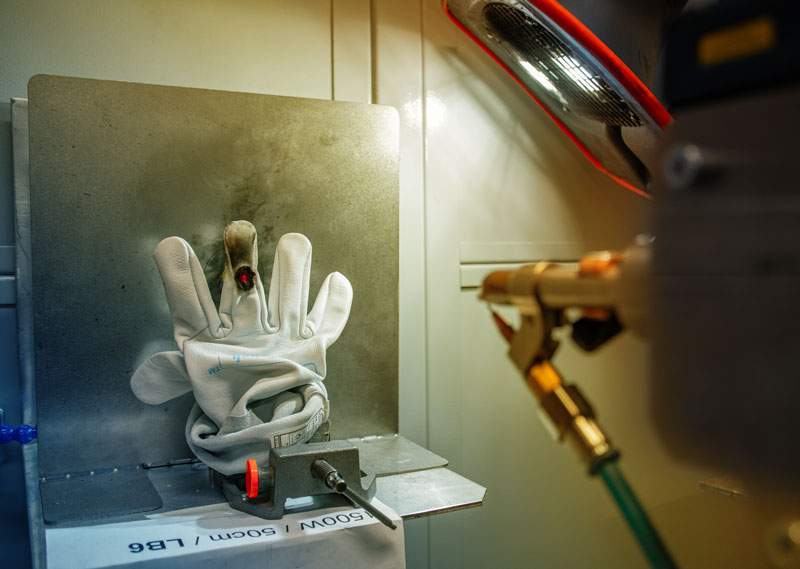
In hand-guided laser welding, the laser beam is moved by hand. This means that the hands are particularly close to the workpiece and the laser beam, and welders must be protected from reflective laser radiation and UV radiation. At the same time, however, the gloves must also be comfortable enough to enable welding work to be carried out over long periods of time. A degree of flexibility is also required in order to position thin or small workpieces correctly.
In the HaLP project – Hand-guided laser beam welding in practice – we are working together with TITV e. V. in Greiz on the special requirements that protective gloves must meet for manual laser welding.
In this project, we want to define the protective requirements for gloves used in hand-guided laser beam welding and play a key role in their development. While TITV e. V. is working on the textile technology development, ifw Jena is conducting practical tests on the protective effect of the gloves. To this end, conventional welding gloves are first exposed to the laser beam to determine its effect on different materials. The distance and laser power are varied in the tests. The test results then help to define requirements for laser welding gloves that provide optimum protection for welders. In addition to the protective effect, the comfort of the gloves is also being investigated in order to develop recommendations for the optimal design.
In close cooperation between TITV e. V. and ifw Jena, comfortable and safe protective gloves are being developed specifically for hand-guided laser beam welding.
The project is part of the overall project “Development of innovative protective gloves for hand-guided laser beam welding, taking into account the requirements of real laser beam welding processes” and is funded by the Federal Ministry for Economic Affairs and Climate Protection as part of the INNO-KOM program.
