


Optimal Additive Processing of Copper
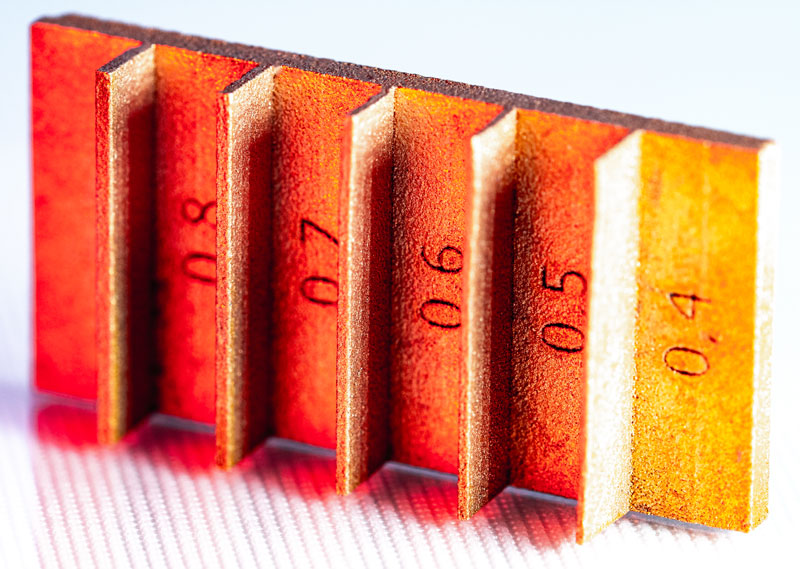
The effectiveness of components designed to regulate temperatures in processes often depends not only on the material but also on the component’s geometry. Fins, channels, and other components must be designed to dissipate generated heat as quickly as possible. To achieve ideal results in the design process, the advantages of additive manufacturing processes are often leveraged. This allows components to be designed with precision and intricate detail, enabling heat sinks to be lightweight, compact, and yet highly efficient.
In collaboration with Active Medical Xcellence GmbH, ifw Jena is developing heat sinks for ultra-compact laser systems used in urology. The goal is to combine the design advantages of additive manufacturing with the excellent thermal conductivity of copper.
However, additive manufacturing of copper poses challenges for manufacturers. Due to its high reflectivity, only a small portion of the laser energy penetrates the copper powder bed. Powder-bed-based 3D printing therefore requires high laser power to produce sufficiently strong components. Only a few powder-bed systems offer the necessary laser power of approximately 700 watts.
To process copper additively in a more resource-efficient manner using equipment already available in-house, the ifw Jena is investigating how copper powder can be melted even with lower laser power. To this end, various system parameters are being adjusted and tested to produce copper samples